Saturday, June 11, 2016

261.766 Narrative

261.766: Teaching for e-Learning

Learning outcomes:

Students who successfully complete this course should be able to:
  1. Demonstrate in-depth understanding of the central concepts, theories, and current areas of debate in the study of teaching in online environments; 
  2. Identify, discuss and analyse the roles and responsibilities of the teacher in E-Learning situations and demonstrate their application in practice; and 
  3. Define teaching challenges arising from the use of educational technologies for distance and distributed teaching in their own educational setting and develop, discuss and implement ways of meeting those challenges in that setting 

This is one of three eLearning papers I have chosen to undertake this year. I have always had an interest in eLearning and the opportunity arose where I am in a position to extend my learning through completing a post-graduate diploma.

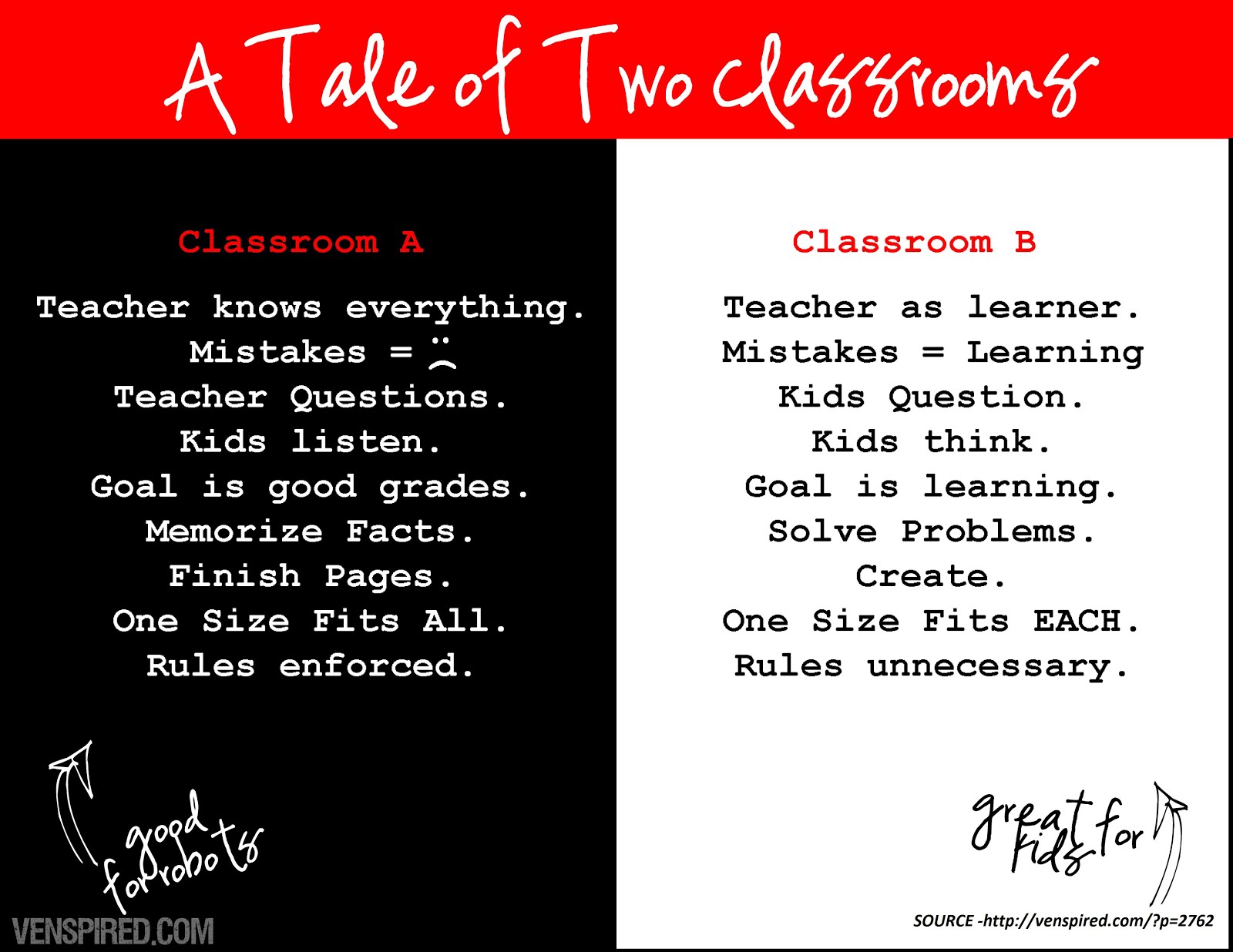
This blog represents my learning throughout this paper and the artefacts that are included help provide evidence. I have included the poster from Vensipred as ultimately I would like my eLearning environment to fit squarely on the right side, as classroom B.

I come to this paper as a learner and Module One is about What’s behind my teaching?  After establishing what I wanted to get out of the course as shown in Artefact 1 considering the perspectives I hold as a teacher as shown in Artefact 2 is important. As Pratt (1998) argues that without careful and critical analysis there is no change in practice. My TPI results show that I am strongest in Developing and Nurturing. Artefact 3 involves me reflecting on my views of teaching and recognising the similarities and differences between my views in teaching and my teaching practice.  This was a good exercise to complete because it made me think about what I have been doing in the classroom and if they really are what I believe should be happening. Further to this, I also reflected on whether my teaching practice requires revolution (extreme change), evolution (gradual change) or leaving it as status quo as shown in Artefact 4. As demonstrated in the artefact, I believe that my teaching practices are always requiring refining and improvement.

Links with Learning Outcomes:
  1. Demonstrate in-depth understanding of the central concepts, theories, and current areas of debate in the study of teaching in online environments.
  2. Identify, discuss and analyse the roles and responsibilities of the teacher in E-Learning situations and demonstrate their application in practice.

Module 2 focuses on the theoretical foundations of teaching for e-learning and provided the theoretical foundation for the entire course. This module was the most interesting and most powerful for me.  It really made me think about what programs I provided in an eLearning context. Artefact 5 focused on the aspects of the Howland, Jonassen and Marra (2011) reading and making a choice on which was the most relevant.  This reading I found was a reading I referred to quite regularly once I understood the focus of the reading whilst I didn't quite understand at the time, and it has hit me right now, it is focused on student engagement through providing meaningful learning. Choosing whether it was pedagogy first or technology first was a challenging task as shown in Artefact 6.  For me, this is because I have always loved using technology in the classroom because I have seen the potential. As a final task to the module, I reflected on my learning journey through a Synthesis Discussion as shown in Artefact 7.

Links with Learning Outcomes:
  1. Demonstrate in-depth understanding of the central concepts, theories, and current areas of debate in the study of teaching in online environments.
  2. Identify, discuss and analyse the roles and responsibilities of the teacher in E-Learning situations and demonstrate their application in practice.
Engagement with eLearning was the focus of Module 3 this had a focus on the learners perspective which is an important aspect of the purpose of education is to educate students. Our online discussion lead to being asked to rank the recommendations.  This was not an easy task and I am sure that if I were to spend more time on this it would look quite different than shown in Artefact 8.  I was more focused on the course design, as this is an important factor of providing meaningful learning and encourage active engagement, I suppose it could be said that I had my teacher hat on through this exercise. Readings such as Zepke and Leach (2010) and Gibbs & Poskitt (2010) made suggestions for improving student engagement.  One of these focused on self-efficiency. This reminded me of Carol Dweck (2014), and her Growth Mindset theory which is very pertinent in our education today.  

As part of being a critical practitioner identifying where there are failures in our teaching and learning program are important and my reflection of a lesson plan that didn't work out as intended is shown in Artefact 9.  This is only one example of when it did not turn out as intended.  There have been others and I am sure that there will be more in the future.  Reflecting and identifying where there is room for improvement is part of the process.  Learning not to repeat such failures is the key.

Links with Learning Outcomes:
  1. Demonstrate in-depth understanding of the central concepts, theories, and current areas of debate in the study of teaching in online environments.
  2. Identify, discuss and analyse the roles and responsibilities of the teacher in E-Learning situations and demonstrate their application in practice.

The focus of Module Four was the roles and responsibilities of teachers teaching in eLearning environments and some of the issues that arise through the adoption of eLearning. Many of these I have experienced first hand in my teaching position.  Zaka's (2013) reading was easy to relate to, as shown in Artefact 10 as the school I was employed in is currently in this position. I have learned first hand that the role of leadership is crucial when implementing a blended learning environment.  I am hoping that the school I am employed in next year has a different  perspective that I have previously experienced. Artefact 11 is about the eLearning competencies. I have chosen to include this reading because the spirit of the New Zealand Curriculum (2007) is based on the front end of the document and this is where the Key Competencies lie.  I have always felt that the Key Competencies are the ultimate goal of education.  Looking at the eCompetencies seems more prevalent as we move forward into eLearning and they compliment the Key Competencies.

As a conclusion to Module Four and the conclusion of this paper, it is then time to reflect on this learning journey, as shown in Article 12 and Article 13 and it has been a journey.  I have started to find answers to questions that I have had for a long time and now wish I had sourced earlier. eLearning is a way forward for education and I am looking forward to implementing what I have learned next year in my own classroom.  I believe that readings like Howland, Jonassen and Marra (2011), Bonk & Khoo (2014), and Gibbs & Poskitt (2010) are going to be part of my pedagogical library for a long time coming. It is a teacher's goal to provide actively engaging learning experiences to our learners and through a well planned eLearning environment our learners have the potential to become the very best that they can be.  The final artefact that demonstrates my learning journey is this narrative and I hope that I have given this course justice with the artefacts chosen. 

Links with Learning Outcomes:
  1. Demonstrate in-depth understanding of the central concepts, theories, and current areas of debate in the study of teaching in online environments.
  2. Identify, discuss and analyse the roles and responsibilities of the teacher in E-Learning situations and demonstrate their application in practice.
  3. Define teaching challenges arising from the use of educational technologies for distance and distributed teaching in their own educational setting and develop, discuss and implement ways of meeting those challenges in that setting.


Bonk, C. J., & Khoo, E. (2014). Adding Some TEC-VARIETY: 100+ Activities for Motivating and Retaining Learners Online, 367. http://doi.org/978-1496162724

Dweck, C. (2014). Carol Dweck: The power of believing that you can improve | Talk Video | TED.com. Retrieved from http://www.ted.com/talks/carol_dweck_the_power_of_believing_that_you_can_improve?language=en

Gibbs, R., & Poskitt, J. (2010). Student engagement in the middle years of schooling (years 7-10): A literature review. Wellington, NZ: Ministry of Education.

Howland, J. L., Jonassen, D., & Marra, R. M. (2012). Meaningful learning with technology (4th ed., pp. 1–19). Boston, MA: Person Education, Inc.

Ministry of Education. (2007). The New Zealand Curriculum. Wellington: Learning Media. Retrieved from http://nzcurriculum.tki.org.nz/the_new_zealand_curriculum

Pratt, D., & Associates. (1998). Alternative frames of understanding. In Five perspectives on teaching in adult and higher education (pp. 33–53). Malabar, FL: Kreiger.

Zaka, P. (2013). A case study of blended teaching and learning in a New Zealand secondary school , using an ecological framework. Journal of Open, Flexible, and Distance Learning, 17(1), 24–40.


Zepke, N., & Leach, L. (2010). Improving student engagement: Ten proposals for action. Active Learning in Higher Education, 11(3), 167–177. http://doi.org/10.1177/1469787410379680

Module Four reading: Guzman & Nussbaum 's (2009)


Outcome: Familiarity with shift required for teaching with technology practice.


Although I had not seen eLearning competencies used in this manner before, I do see the purpose of Guzman & Nussbaum 's (2009) analysis. We speak of the competencies that students need to develop in order to become 21st Century learners. When I reflect on some of the challenges I have encountered with other staff at school, I can see where they fit within the competency domains and where their next steps in learning are. It would to useful to use the basis of this as part of a staff self-reflection, particularly if our school is to significant progress in integrating digital technologies into the classroom program. However, I am unsure if the order of the domains is effective. I question should attitudinal be the last domain? Personally, I would have placed it higher on the list. This is because without an attitude to incorporate digital technologies in a learning perspective it can be easier to fall on the tried and true.

One area that appears to be missing is competencies about digital literacy; the ability to search for information effectively, to think about your digital footprint, to adhere to copyright laws, etc. This is an area where many staff struggle. It could be encompassed in the instrumental domain, however, this is unclear.

This article did get me thinking about my own practice. Where did I think I fit? What areas did I need to focus on? I am personally comfortable with a multitude of applications and always willing to learn tricks and techniques that make it easier for the learner. I am confidently able to solve various technical issues. Since I love using digital technologies, I am always trying to purposefully integrate them into the classroom program as much as I can. Although I now take heed of Howland, Jonassen, & Marra's (2012) article of the difference between learning with than from digital technology. Frameworks such as the TEC-VARIETY (Bonk & Khoo, 2014) are also beneficial to make changes in the teaching and learning programs.

I have always been a reflective practitioner, especially ways to improve the learning and how to ensure tools used meet the learning needs of my learners. Where I need to focus more on is the communication aspect. I do so orally, however, I need to work on utilising the digital tools to do so as well. As for my attitude, I want to integrate them, I can see potential, and right now I am working on developing my pedagogical approaches further.

Guzman, A. A., & Nussbaum, M. M. (2009). Teaching Competencies for Technology Integration in the Classroom. Journal Of Computer Assisted Learning, 25(5), 453-469.

Module Four Reading: Zaka (2013)


Outcome: Familiarity with factors affecting teaching with technology, particularly in a blended learning environment.
Pre-reading questions

Blended learning has come to have a few different meanings. How would you define it?

Blended learning can be defined as an effective mix of web-enhanced and face to face learning. This can occur in the classroom via distance learning that incorporates Video Conferencing


Post reading questions

What are some of the challenges facing teachers who are involved in blended learning? What is the role of the school in supporting the teachers?


Zaka (2013) describes some of the challenges that teachers face whilst involved in blended learning. These include limited access issues, student’s readiness for blended learning, usability of tools that don’t link well together, building staff capacity, limited parental support. These are challenges I can identify with coming from a small rural school too. I have an appreciation for learning via distance through a blended learning environment as many of the students we have undertake learning through VC. Students who do well are those who do have an internal motivation to achieve and apply themselves to their learning. I also understand the need to build capacity with staff. At our school the uptake of blended learning is very low for a variety of reasons. For myself, I have had to rely on outside professional development and Communities of Practice to build my own capacity. I use these ideas in my own classroom practice as well as assist other staff with possible ideas to integrate digital technologies into their own classroom practice.

The role of the school, in particular, the school leadership team, in supporting teachers who are implementing blended learning is imperative. The quote from the eprincipal “we might have teachers doing innovative things but without leadership [there will not be change]” resonates with me as it identifies where I have experienced challenges within my own school context. Effectively implementing a blended learning environment is challenging there is a different pedagogy involved. The teacher’s role is more of an instructional designer as well as the teacher/facilitator. I have taken the position to extend my own ideas further by attending professional development linked with implementing digital technologies into classroom programs mostly out of school hours and out of my own pocket. This paper included. Within our school there is a definite need for more school professional development where blended learning is concerned.

Task 2.1 - The Key Aspect

If I have to propose a stand to one of the aspects I choose Active. Whilst I agree that all aspects of Howland, Jonassen and Marra (2011) are important and link so well with each other. I feel that without active participation from the learner then I feel the rest falls beyond meaningful learning.

In my view, active learning falls beyond the physical movements that can be seen. As a learner, I choose if I am going to engage in the learning process (whether that is on a physical level or on a cognitive level). When I do, then I am an active learner I have put myself in a position to learn.

I can definitely see that if I don't see the learning has value then I am less likely to actively participate within the learning process and maybe I miss out on learning opportunities.

I also see that in the classroom, especially when teaching "Scratch" or "Kodu". There is an intentional goal (to learn how to make your own game), collaborative/cooperative learning (learning with and from others is encouraged), it can be constructive (each idea builds to create the coherent whole and without thinking about how things link together it doesn't make sense), you can apply it to an authentic context (as the game created can be played by/with friends). However, even when some learners go through the motions (ie, complete tasks) if they do not actively apply themselves to the learning then they don't get the "learning". Which is seen when students get to the point where they should have the skills to create their own game yet are lacking skills to do so.

Reflecting on Howland, Jonassen and Marra (2011)'s reading the students appear to have missed "observing the effects of their interventions and constructing their own interpretations of the phenomena and the results of their manipulations" Which one could easily say the learners have not reflected on their activity and observations which fits with "constructive".

Hmm.. one thinks one could keep going around in circles because whilst the students went through the motion of doing the task (which fits within the active component) I find that without cognitive engagement through observing what you do and the effects (i.e. It can be difficult to learn to programme without "doing it yourself") then have the learned anything?

Reflecting on this further:

Ok.. I want to learn to plaster Gib (very relevant and my partner wants at least a level four finish)

So, therefore, I have an Intentional goal in an Authentic context. I can learn from others (YouTube, people I know, bloggers, home improvement sites, etc) which fits within the Cooperative aspect. I can reflect on the advice given, take on board all sorts of helpful hints I ensure I have all the tools requires and "see it it my head".

From this one could be considered an expert. I have learned something that is going to help me finish my house/rooms??? Wrong!!! It isn't until you actively do the task (in this case physically put plaster and tape on the Gib) do you realise what you do and don't know. Through the observations of my actions and whether the paper tape actually is adhered properly and you can't see it anymore.

Task 4.1 My Reflection #1

The above quote has always resonated with me. Learning is a journey; it is one with road forks, uphill challenges, roadblocks, clear pathways and sights to see along the way. Learning isn’t always easy, and it shouldn’t be all the time.

This eLearning paper has challenged me in ways that have changed my thinking towards the implementation of eLearning within my classroom programs. Although I had the intention of focusing on the learner, there are times where the constraints of time, management, and missing information have had its impacts and maybe my intention was not presented to its fullest.

Pratt & Associates (1998), challenged the idea of looking at one's self and understanding where we come from, our own perspectives, to make progress going forward. This is so true, and difficult at times, to say the least. How does one recognise one's weaknesses without overlooking one's strengths or vice versa?

Over the past few years, I have been searching for the missing link in my theoretical understandings and through this course, I have started to find the answers I have been looking for.  I knew that pedagogy was the key to unlocking learning from a students’ perspective however I was missing some of the theoretical foundations to take this to the next step.

Assignments like the Critical Elements and the eLearning Planner were challenging yet rewarding. There is a significant difference between acquiring knowledge and using it in a constructive way.  Much like the difference between the Acquisition Metaphor and Participation Metaphor discussed by Sfard (2015).  

The use of eLearning opens doors of opportunities, yet it is more than knowing about the wide variety of technologies, Web 2.0 tools, and applications available, it is about using these tools in ways that enhance the learning and increase learner agency. A seamless integration whereby the focus is on the learner and the teacher is a facilitator within the process during which students are encouraged to inquire, experiment, design, communicate, collaborate, write, model and visualise with technologies (Howland, Jonassen, & Marra, 2012). This is a challenging prospect, yet achievable.

Has my learning journey come to an end? As the image above clearly states, learning is a journey, there is much more to learn despite this paper coming to the end.


Howland, J. L., Jonassen, D., & Marra, R. M. (2012). Meaningful learning with technology (4th ed., pp. 1–19). Boston, MA: Person Education, Inc.

Pratt, D., & Associates. (1998). Alternative frames of understanding. In Five perspectives on teaching in adult and higher education (pp. 33–53). Malabar, FL: Kreiger.

Sfard, A. (2015). On Two Metaphors for Learning and the Dangers of Choosing Just One. Educational Researcher, 25(4), 4–13. Retrieved from http://edr.sagepub.com.ezproxy.massey.ac.nz/content/27/2/4.full.pdf+html


Task 3.3 Pitfalls with Learner Engagement

As part of my digital technologies program, I had introduced Scratch to the year 7’s and 8’s. I had uploaded the necessary videos and resources on the school network for the students to follow and complete the same exercise themselves.

When I tried this with the year 7’s I had shown them how to access both Scratch and the learning resources required. In one class I found it interesting that they watched the videos with great intensity, however, I must not have been very clear with them about how to use the video and create at the same time as many were unsure what to do once they had watched the video. I had to slap myself on the hand at expecting students to somehow know.

I found the year 8’s were able to multitask a whole lot easier, although I noted there were a small group of boys who would go through the process and complete the activities yet when I provided them with a task that used the previous learning they struggled with doing the basics. At the time, I recognised that they had not engaged with the material enough to apply it to new contexts. What I also found interesting with these boys was when I posed questions back about which videos we could review to help us with the given task they were unable to do this independently. Yet, I know that if I had said to them to find a Scatch game to analyse they wouldn’t need my help or guidance.

Task 1.4 Revolution/Evolution/Status quo

Teaching is an ever-evolving process. I do not think that it is possible to stay stagnant. My journey as a teacher changes with each person I meet, each reading I read, and through critical self-reflection. As Sfard (2015) points out there is a difference between acquiring knowledge and participation in developing knowledge. If I consider what type of teacher I was when I started teaching 10 years ago and where I am now there are considerable differences. Where eLearning is concerned, it is no different. I have always seen that digital technologies has the potential to engage students in ways that allow the students to take personal responsibility for their own learning. In saying that, there is so much to learn about the most effective ways to integrate digital technologies into the classroom context within compulsory education for the benefit of the learners and their achievement. Therefore, I tend to lean towards evolution within the realms of adopting eLearning as part of my classroom practice.


Howland, Jonassen, & Marra's (2012) reading reiterates my thoughts about technology is only a tool for students to use. In saying that, their point about learning with versus learning from technology struck a chord (Howland et al., 2012). Has my classroom program encouraged learning with technology? Upon reflection there are parts that I can confidently reply yes, others well, there is room for significant improvement. The ultimate goal as a teacher is to have personally responsible, actively engaged learners who active at their highest ability, no matter their given starting point. There are challenges and one wonders if this is because of the difference between teaching years 7-10 and the constraints of NCEA assessment at senior level or is that my perspective? I now can see another approach for at least one of the Digital Technologies Achievement Standards and maybe I can provide the “meaningful learning” as described by Howland et al. (2012) by utilising ideas from both Howland et al. (2012) and McLoughlin & Lee (2008) starting with implementing more of a constructivist approach to the program.

Learning is considered to be a life long journey and as such I am always learning, this course is part of my learning process. The rapid expansion of digital content and digital tools impacts on both my personal and professional life, and one would hope, hopefully for the better. The incorporation of digital technologies into the classroom program requires careful consideration in order to achieve maximum benefit. To me, there is much more to learn. After all, the purpose of education is to develop our learners into confident, independent learners ready for the 21st Century. I have never been one to think I hold all the knowledge and students must learn from me. To me, learning is a journey and I am able to learn with and from the students I have in my charge. The ultimate goal of a teacher is to enrich the lives and ideas of our learners and integrating digital technologies provides a does provide a gateway to achieving that goal if implemented with the needs of the learners in mind. We do need to remember it is just a tool and without employing the right pedagogy the novelty of implementing eLearning has no additional benefit for the learner. Which is why I believe that adopting eLearning into my classroom my pedagogical practice is always evolving.


Howland, J. L., Jonassen, D., & Marra, R. M. (2012). Meaningful learning with technology (4th ed., pp. 1–19). Boston, MA: Person Education, Inc.

McLoughlin, C., & Lee, M. J. W. (2008). The three P’s of pedagogy for the networked society : Personalisation , participation, and productivity. International Journal of Teaching and Learning in Higher Education, 20(1), 10–27.

Sfard, A. (2015). On Two Metaphors for Learning and the Dangers of Choosing Just One. Educational Researcher, 25(4), 4–13.